Moving Banner to Ellucian SaaS: A Practical Migration Plan
A SaaS move changes how you customise, report and integrate. A five-phase plan that avoids the common surprises.
How do you plan a Banner SaaS migration?
Plan a Banner SaaS migration in five phases: inventory everything that touches Banner, classify each item (retire, reconfigure, rebuild or re-platform), rebuild integrations on Ethos APIs, rehearse the cutover with data validation at least twice, and run a hypercare period while the team adopts the new operating model.
More institutions are moving Banner from on-premises data centres to Ellucian SaaS. The appeal is clear: continuous updates, less infrastructure and a smaller patching burden. But SaaS also changes the rules for customisation, reporting and integration. See Banner SaaS vs on-premise for the comparison.
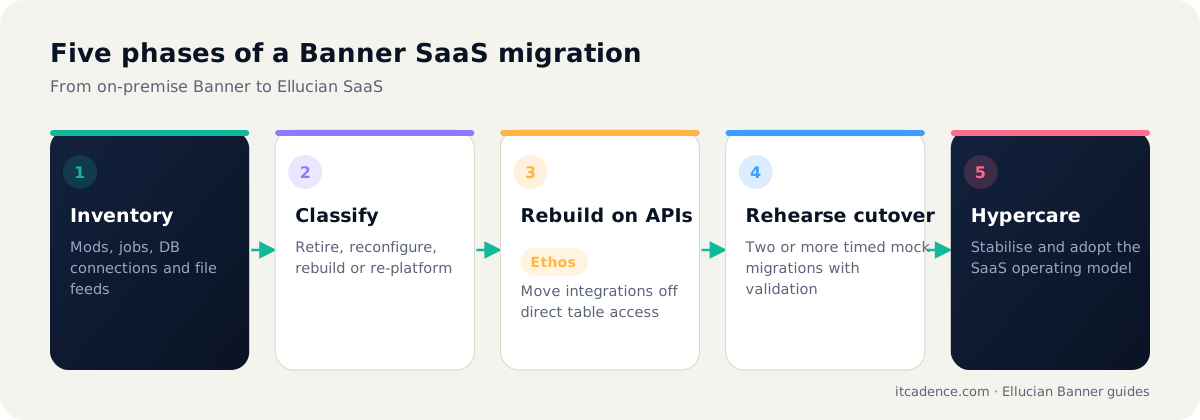
Phase 1: Inventory everything that touches Banner
- Local modifications to baseline pages, packages and tables
- Custom PL/SQL, Pro*C and shell jobs in job submission
- Direct database connections from reporting tools, scripts and third parties
- File-based feeds in and out (bank files, LMS, ID cards, housing)
In SaaS, direct database access and arbitrary server-side code are generally restricted, so each item needs a new home.
Phase 2: Classify and decide
- Retire: no longer used or replaced by delivered functionality.
- Reconfigure: achievable with baseline rules and settings.
- Rebuild: move to Banner Extensibility, Experience or Ethos APIs.
- Re-platform: shift reporting to a supported analytics approach.
Note: Expect the inventory to be larger than anyone estimates. Undocumented scripts on a forgotten server are a migration classic.
Phase 3: Rebuild integrations on APIs
Integrations that read tables directly should move to Ethos APIs and change notifications. API-based integrations survive updates far better.
Phase 4: Rehearse the cutover
Run at least two full mock migrations with validation scripts that compare record counts and key balances. Time each rehearsal; that becomes your cutover estimate.
Phase 5: Hypercare and a new operating model
After go-live, your team shifts from running infrastructure to managing a service: tracking Ellucian's update schedule, regression testing and owning configuration. Budget for hypercare and retraining.
Migrating to SaaS is not a lift-and-shift. It is an opportunity to pay down a decade of technical debt.
ITCadence supports assessment, rebuild and hypercare. Start with a readiness assessment.
Frequently asked questions
Underestimating the inventory: undocumented scripts, direct database connections and modifications that must be rebuilt.
At least two full rehearsals with validation scripts, timed so you can estimate the real cutover window.
Last reviewed by the ITCadence Banner team. Ellucian product capabilities vary by version and licence; confirm details against current Ellucian documentation.